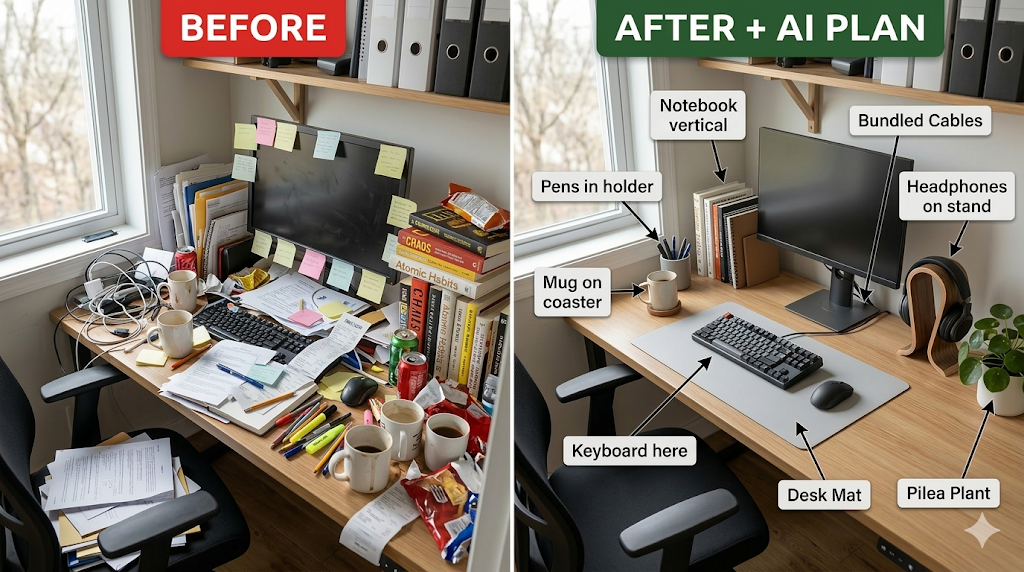
How to Organize a Home Office Desk for Notes and Light Paperwork
A home office desk used for notes, planning, and light paperwork usually gets messy in a very specific way.
The main screen holds the center. An open notebook stays out longer than it needs to. A few forms, receipts, or printed pages feel too important to put away, so they stay flat on the desk. Pens, chargers, sticky notes, and one or two reference items start collecting around the edges because each thing looks small on its own. The desk still works, but it stops feeling clear.
That is what many people really mean when they search for ways to organize your workspace or think, “I need to organize my office.” They are not trying to create a perfect minimalist setup. They want one realistic desk that can support screen work, handwritten notes, and small paper tasks without turning into a constant reset.
TidySnap helps at exactly that point. You can upload a real photo of your desk and turn general advice into a visual plan based on your actual surface, note-taking habits, paperwork flow, and the clutter zones that keep returning.
Quick Answer
If you want to organize a home office desk for notes and light paperwork, start here:
- decide what belongs in the center during screen work versus paper work
- keep only one active notebook or document open at a time
- give light paperwork one contained home instead of several loose piles
- group pens, chargers, and small tools into one support zone
- stop the area below the monitor from becoming storage
- keep cables out of the writing path
- reset the desk back to one default layout at the end of the day
For most people, that does more than buying another organizer.
What People Usually Mean by Notes and Light Paperwork
This kind of desk has to support three categories that overlap easily:
- screen-based work
- handwritten notes or planning
- minor paperwork like receipts, forms, printed pages, and mail
None of those creates chaos alone. The problem is that they all compete for the same visible center.
That is when the desk starts holding:
- one notebook from earlier in the day
- one paper stack that still needs action
- one or two chargers in reach
- pens and sticky notes in multiple places
- reference pages parked near the keyboard
The surface starts acting like both a workstation and a holding area.
Why This Type of Desk Gets Crowded Quickly
A notes-and-paperwork desk often looks manageable because the clutter is not dramatic.
You may only have:
- one notebook
- one active document
- one tray of papers
- a pen cup
- a charger
- a mug
- one or two reference items
But when those items all stay visible at the same time, the desk starts feeling visually noisy even before it feels full.
That is why the best fix is usually not more storage first. It is creating clearer boundaries for what gets the center and what has to move aside.
Protect the Center for the Work You Are Doing Right Now
The center of the desk should support the task you are doing now, not every task you might do later.
If you are doing screen work, the center usually needs to belong to:
- keyboard and mouse path
- main screen line
- one current note at most
- enough open hand space
If you are taking notes, the center usually needs to belong to:
- one notebook or pad
- one writing tool
- enough room to rest your hands
- only the paper directly tied to the note you are making
If you are handling paperwork, the center usually needs to belong to:
- one active document
- one related reference page
- one pen
- no unrelated stacks underneath it
| Work mode | What belongs in the center | What should move aside |
|---|---|---|
| screen work | keyboard, mouse, one active note | extra notebooks, papers, chargers |
| note-taking | one notebook, one pen, clear hand space | backup tech, unopened mail, loose tools |
| paperwork | one active document, one reference page, one pen | old paper, unrelated drafts, extra stationery |
That one distinction makes a desk easier to read and easier to reset.
Give Paper a Boundary Before It Spreads
Light paperwork gets annoying when it stays flat and undefined.
That usually looks like:
- mail near the front edge
- receipts beside the notebook
- printed pages under the keyboard line
- one form waiting for action in the same area as finished paper
A better setup is one paper boundary, such as:
- one thin tray
- one standing file holder
- one folder for pending paperwork
- one small review stack that gets checked daily
The goal is not to hide all paper. The goal is to stop paper from spreading sideways across your work surface.
Use One Support Zone for Small Tools
Many desks feel busier than they really are because the useful small items are scattered.
That often includes:
- pens
- sticky notes
- charger
- headphones
- paper clips
- task pad
- envelopes or receipts waiting for review
A better setup is one support zone on one side of the desk. That zone can hold:
- one pen cup or tray
- one charger spot
- one closed notebook or task pad
- one small place for temporary paper items
Grouping these items reduces visual noise and makes the desk easier to reset.
Stop the Area Below the Monitor From Becoming Storage
A lot of desks lose clarity because the space below the screen turns into a paper shelf.
That area often collects:
- sticky notes
- reference printouts
- pens
- charging cables
- older notebooks
The problem is not just clutter. It is that the area below the screen is visually central.
If it fills up, the whole desk starts feeling busy.
A better rule is simple:
- keep only one current note or one current document near the screen
- move the rest into the paper zone or support zone
- do not treat the monitor base as a storage ledge
Keep Cables Out of the Writing Path
Even one or two visible cables can make a desk feel more crowded than it is.
A stronger default is:
- keep the active charging cable on one side only
- store spare adapters away from the desk surface
- avoid routing cords across the notebook area
- keep the front edge clear enough for writing and sorting paper
| Item | Better location | Why it helps |
|---|---|---|
| daily charging cable | one side corner | keeps the center clearer |
| spare adapters | drawer, tray, or shelf | stops backup tech from becoming clutter |
| paperwork folder | side support zone | keeps documents visible but contained |
| notebook | beside the keyboard area, not underneath paper | protects writing space |
If your hand keeps working around cables, the desk is still doing too much.
A Better Layout for Common Versions of This Desk
Desk used for planning and admin
Best approach:
- keep only one notebook visible
- use one paper holder instead of several small piles
- separate pending paper from finished paper
- leave the front edge open enough for writing
Desk used for screen work plus quick notes
Best approach:
- keep one active note near the keyboard area
- move extra notebooks out of the center
- limit visible accessories to daily-use items
- stop backup items from living below the screen
Desk used for household paperwork too
Best approach:
- keep bills, forms, and mail in one review zone
- do not mix household paper with active work notes
- give receipts and envelopes a faster decision path
- build one short daily reset before paper drifts outward
Where TidySnap Helps
This is where many people stall. They understand the advice in theory, but when they look at their own desk they still wonder:
- which paper should stay visible?
- what belongs below the monitor and what does not?
- where should notebooks live between tasks?
- which part of the desk is actually doing too much?
TidySnap helps from a real photo of your space. It can help you:
- identify which zone is overloaded
- separate active paper from background paper
- protect the part of the desk you actually work on
- reduce small-item spread across the surface
- build a layout you can repeat tomorrow
A 10-Minute Reset for This Type of Desk
| Minute | Action | Goal |
|---|---|---|
| 0-2 | remove trash, dishes, and non-work items | clear fast visual noise |
| 2-4 | return the main work setup to its default position | restore the central work zone |
| 4-6 | close extra notebooks and keep one active one only | reduce note spread |
| 6-8 | move paperwork into one tray or review folder | stop loose paper drift |
| 8-10 | return tools and cables to one side zone | make the desk easier to restart |
Common Mistakes
The most common mistakes are:
- keeping multiple notebooks open because they all feel active
- leaving paperwork flat across the desk because it still needs a decision
- storing paper below the monitor because it feels convenient
- letting chargers and pens spread into the writing path
- using the center of the desk as all-day storage
FAQ
How do I organize a desk when I need notes and paperwork every day?
Protect the center for one mode at a time. Keep only one active notebook or document open, and give the rest a defined paper zone.
What should stay on a home office desk every day?
Usually your main screen setup, one writing tool, one active notebook or note area, and one small support zone for daily tools. Everything else should earn its place.
How do I keep light paperwork from taking over the desk?
Give it one defined home. One tray, folder, or review stack works better than several loose paper spots.
Do I need more storage products first?
Usually no. Most desks improve faster from clearer boundaries than from adding more containers.
A desk like this feels better when the next task is obvious the moment you sit down. That is usually the real goal: less friction, less visual noise, and a workspace that is easier to use again tomorrow.